Greed Is Back

— Thu, 21st January 2010 —


Oliver Stone’s WallStreet — It defined an era of “fuck you” style. Hell, the definitive power shirt — royal blue with white contrast collar — takes it name — the “Gekko” — from the film’s most lasting character. Fast forward over 20 years, and it might be time to give the ol’ “Greed is good” spirit another go, and just in time for Stone’s sequel, Wall Street 2: Money Never Sleeps. Vanity Fair looks into it.

Turnbull & Asser 50% Off

— Thu, 21st January 2010 —

Speaking of superior dress shirts, Turnbull & Asser is now taking at least 50% off most F/W stock — through the end of the month. We’re talking $100 shirts and $50 ties… from perhaps the most prestigious British shirtmaker in existence!

Turnbull & Asser – 42 East 57th St between Park & Madison – 212-752-5700 – Map

Saks’s March Of The Merch

— Wed, 20th January 2010 —

At this very moment, Saks staffers are putting out racks of left-over sales merch — trucked in from across the country — which you’ll find at up to 90% off for the next few weeks. Check it out, and let me know what nuggets you mine in them thar hills! [Madison Avenue Spy]

Saks Fifth Avenue – 12 E 49th St at 5th – Main: 212-753-4000, Suiting: 212-753-2649, Shoes: 212-753-2105 – Map

What’s In A Dress Shirt?

— Wed, 20th January 2010 —

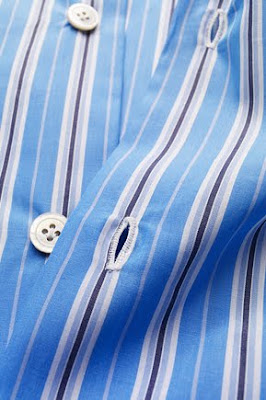
What goes into the making of a superior dress shirt? “The devil is entirely in the details,” writes The Wall Street Journal. “Like the wine market, the ready-made men’s shirt world is crowded with products of varying style, quality and substance … The differences can be subtle — an extra stitch at the back of a button, a bit of glue inside a cuff — but those intricacies determine the way a shirt feels against the skin and how it looks after being cleaned.”

At Charvet or your neighborhood consignment shop, how does one spot quality? Fabric first, one connoisseur tells The Journal. “It should be firm with a smooth feel … A consumer can check the density of the weave by holding a shirt to the light … Light will only partly penetrate a shirt if it’s made of quality fabric with a dense weave.”

Also check the cuffs and collar for a bit of slack between the outer and inner layers of fabric, and the firmer interior material. “A customer should check that the pocket’s stripes or checks are aligned with the background pattern … The yoke and sleeve lines should match; and the collar stand — the piece of cloth below the collar that holds the top button — should line up with the front of the shirt.”

To boot, a shirt’s seams should have a minimum of 15 stitches per inch. The tail should be long enough to stay tucked into a pair of trousers when a person raises his hand, and the side seams should be reinforced at the intersection of the two parts of the tail with a piece of cloth called a gusset.

The Problem With Sample Sites

— Tue, 19th January 2010 —

What’s not to love about sample sale sites like Beyond The Rack, which grant easy access to (oftentimes) great products at up to 70% off retail? Well, for starters, physical sales often offer deeper markdowns, and I much prefer handling a product in person before buying it. (Suits and jackets must be tried on for size, and a digital image will never truly convey how a fabric feels, or what it looks like in the light of day.)

Add to those limitations new claims that some sample sites are artificially inflating their prices. “It’s no secret that the world of discounting relies on higher list prices to boost the appeal of leftover merchandise,” writes The Wall Street Journal. “But questions about fake list prices are spreading, as the Internet also makes it easier for shoppers to discern whether something is truly at discount or not.”

Sale shopping has always been an imperfect science, relying mostly on buyer knowledge and intuition. True or not, these latest accusations of digital price inflation show that — despite the rise of automated, streamlined systems — deal hunting still requires plenty of common sense.